This is part of a series examining ESO sets which provide the Major Slayer group buff, particularly for Magicka compositions. Obviously how to get a group to pump out the most damage is an extremely complex topic, and I won’t presume to know everything or think of everything, but I can go through the things I know. I’m writing this while the Stonethorn DLC is in PTS, so any references to “current” meta refer to the meta as it existed March 26, 2020 through August 24, 2020.
In the Greymoor Chapter, a new Major Slayer set was created, Roaring Opportunist. This set is dropped in the Kyne’s Aegis trial, and (after some fiddling during the PTS cycle) provides Major Slayer to all 12 people in the trial group, but the duration of the buff is tied to how much heavy attack damage the wearer can do with a single heavy attack.
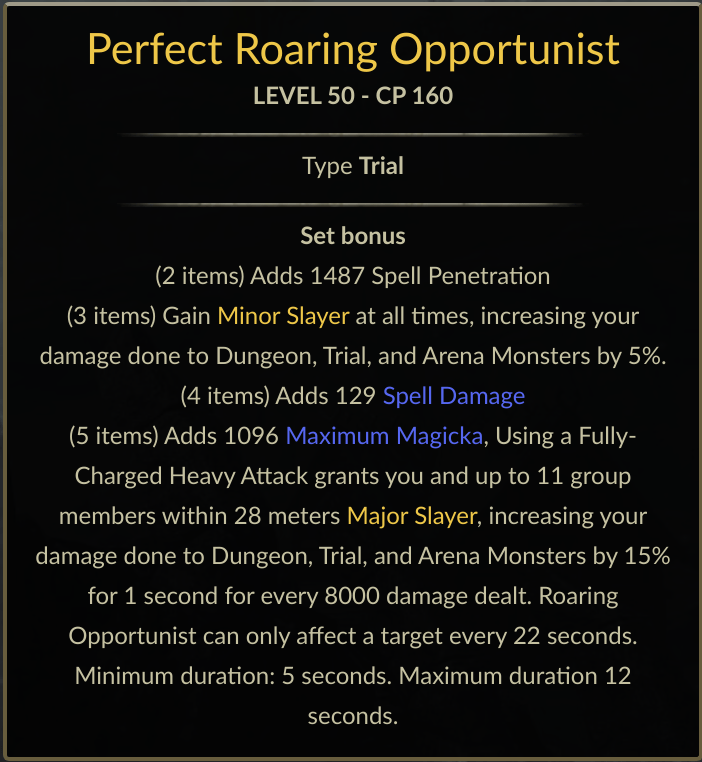
ZOS has intentionally tried to position this set as intended for a single DD to run in the trial, and was clearly intended to match the heavy-attack combat change which never actually went live. Intent notwithstanding, it’s pretty much run exclusively by healers in Greymoor, who pair it with Jorvuld’s Guidance and stack damage/combo setup into heavy attacks, mostly following stileanima’s lead:
When you pair Roaring Opportunist with Jorvuld’s Guidance, you increase the duration of the Major Slayer buff provided by 40%, which means a 96,000 heavy attack will grant 11 group members up to 16.8 seconds of Major Slayer, for a total of 184.8 seconds.
Naively, that’s three times as much Major Slayer as you would get with the Elsweyr-era Master Architect dual-stack, assuming your Master Architect wearers were using their ultimates every 20 seconds.
Unfortunately, we don’t care about a third of the group, because tanks and healers don’t need Major Slayer. A 15% buff on the 10k DPS your tank is doing comes out to a whopping 1.5k DPS, so it’s not even worth considering the effects of slayer on your supports. You really only want to consider the 8 DPS, which will get a practical duration of 134.4 seconds.
Still, that’s over twice the buff provided by the dual-stack tactic. The downside is you need to put this set on the healer who would otherwise be wearing Zen’s Redress and Martial Knowledge, on the assumption that Olorime is simply too good of a buff to give up, even for Major Slayer.
Would a theoretical 75% uptime on a 15% damage done buff be worth sacrificing the theoretical damage buffs of Zen’s and Martial Knowledge provided by the healer in those sets? Yes, but only just barely: 75% theoretical uptime on 15% damage is 11.25%. 100% uptime on Zen’s is 5%, and Martial Knowledge is 8% for 5 seconds on an 8 second cooldown (5/8 * 8% = 5%, obviously), so combined they give you a theoretical maximum of 10%. Worse than Roaring Opportunist’s theoretical maximum, but what about the practice?
This is strictly a false dichotomy, if a Templar in Zen’s and Martial Knowledge is replaced by a Nightblade in Roaring Opportunist, Zen’s will be moved to a Magicka Dragonknight DPS. The symmetry between the heavy class focus on flame-based damage over time abilities, the DoT running-time extensions provided by Elf Bane, and the DoT-based debuff provided by Zen’s is fairly straightforward to understand.
The Difficulty
Put bluntly, it is simply very difficult for most people to actually pull that combo off, because the combo consists of some version of this:
- Light Attack + Simmering Frenzy (on)
- Light Attack + (other ability, Frenzy buff: 660 spell damage)
- Light Attack + (other ability, Frenzy buff: 726)
- Light attack + (other ability, Frenzy buff: 798)
- Light Attack + Incapacitating Strike (+25% damage, Frenzy buff: 878)
- Full Heavy Attack (3s) + Shadowy Disguise (guaranteed critical strike, Frenzy buff: 1168)
- Light Attack + Simmering Frenzy (off)
The “other ability”, and exactly how many of them are casts before going into the combo itself differs from attempt to attempt, in order to refresh Unstable Wall of Elements, Dark Shade, etc., and whether the heavy attack is timed to hit while Warhorn and Colossus are active.
The difficulty here is the vampire toggle, Simmering Frenzy. In exchange for the steadily growing spell damage, you receive a steadily increasing health cost. With vampire stage one, this works out to:
- Light Attack + Simmering Frenzy (on)
- Light Attack + (other ability, -1,805 health)
- Light Attack + (other ability, -2,166 health)
- Light attack + (other ability, -2,599 health)
- Light Attack + Incapacitating Strike (+25% damage, -3,119 health)
- Full Heavy Attack (3s) + Shadowy Disguise (guaranteed critical strike, -13,622 health)
- Light Attack + Simmering Frenzy (off)
Note here that the buff increases by 10% per second, eventually topping out just shy of 1.2k extra spell damage, the health cost is also increasing by 20% per second, and you pay that cost every second. So in exchange for that 1,168 spell damage, you pay a total cost of 23,311 health over 7 seconds, which means you would want to have an average heal over time of 3,330/s to compensate for the health drain on a stage one vampire.
This is all complicated by the fact Simmering Frenzy prevents you from being healed by anyone but yourself while it is active, and will toggle itself off if you don’t have enough health to support the next tick.
In Practice
A quick perusal of ESO logs for the Rakkhat Hard Mode fight shows that even getting 50% uptime out of Roaring Opportunist is tough to accomplish even for experienced endgame players–the best I saw among the few who actually pulled it off was 46% uptime, which works out to 6.9% extra damage.
To continue the example above, the best Templar healer in Zen’s and Martial Knowledge maintained a 67% uptime on Zen’s, and 100% uptime on Martial Knowledge, for a damage buff of 8.35% in that fight. They also did 40k DPS, as opposed to the Roaring Opportunist wearer’s 20k.
One healer I talked to about this build also mentioned that a very real difficulty of executing this seven-step, ten second combo every 22 seconds in the middle of the the trial around you. Anything that incapacitates you during the combo, for example, makes it dramatically more likely that Frenzy toggles itself off due to lack of health, in which case the healer needed to heal themselves back to full, and restart the combo from the top, which is pretty killer for uptime.
For the best groups, it’s maybe possible to simply skip these incapacitating mechanics: a 2-pad burn on Rakkat, for example, would skip cores, meteors, and restrict the group to dealing with one Hulk, and no more than two knock-backs. Most runs, however, are not going to include every core, knock-back, orb, and bash being handled perfectly, which means it’s actually quite difficult to even get enough practice using Roaring Opportunist in a practical raid environment to make it worthwhile.
And, of course, everything is changing…
 Nostrabar